
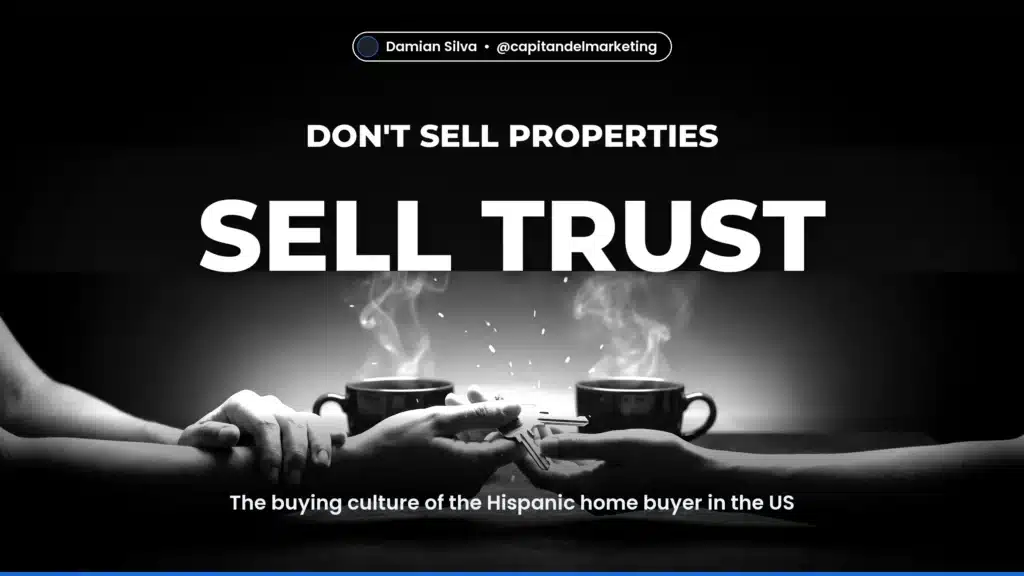
There is something the numbers never quite capture: the Hispanic buyer in the US is not buying a property. They are buying a step for their family — proof that the sacrifice of coming here was worth it, the room of their own for the kids, the place where Sunday gatherings happen.
The agent who understands that serves differently, communicates differently, and closes differently. The one who treats it like just another transaction loses the client to an agent who did understand — even if that other agent knew less about contracts.
I have worked with latino realtors in the US since 2019, and this article gathers the patterns that repeat across their markets, from Florida to Texas to Georgia. With one honest caveat: these are patterns, not labels. Every family is its own world, and the first rule with any client is to listen before assuming.
Who the Hispanic buyer is (and what moves them)
The Hispanic buyer comes from very different origins — Mexico, Central America, the Caribbean, South America — and it shows in how they speak, what they eat, and who they trust. But there are motivations that repeat with force:
- The home as the destination of the effort. For many families, owning is THE goal that justifies years of work. It is not an “asset”: it is the finish line.
- Protecting what they earned. The distrust of economic instability — inherited from our home countries — makes a house feel safer than any other option. That is also why some buy as an investment in addition to their own home.
- Stability for the kids. The school, the neighborhood to grow up in, not moving every time rent goes up. When you listen to the real motivation, there is almost always a child’s name in the sentence.
- The decision is a family one. Even if one person signs, several decide: the spouse always, and often the parents, the in-laws, or the sibling “who already bought and knows.” Selling to the Hispanic buyer is selling to a table, not an individual.
The myths that hold your client back (and that you can dismantle)
A good part of the work with Hispanic buyers is not selling: it is dismantling beliefs that have them stuck. The three most common:
- “I need 20% saved.” The most expensive inherited myth. There are loans with much lower down payments and programs that help with the down payment — the full picture is in down payment assistance, the help almost nobody uses right.
- “My credit isn’t enough” (or “I have no credit”). Many rule out buying without ever talking to a lender. Short credit history, the ITIN, the ways to build credit: all of it has paths the client does not know about. How to ask those questions without ruling anyone out on assumption is in ITIN, credit, and how to qualify buyers who actually buy.
- “If I get rejected, I’m marked.” The fear of asking and “looking bad” is real and silent. That is why educational content in Spanish works so well: it lets the person learn without exposing themselves, until they feel ready to talk.
One rule for all three cases: never promise results or figures. Your role is to open the door of information and walk them to the right financing professional. Clarity builds trust; inflated promises destroy it.
Trust is built before the first appointment
In Hispanic culture, the relationship comes first and the business second. That changes the order of your marketing:
- Educate before you sell. The short Spanish-language video that explains “how the process works here, step by step” is worth more than ten “buy with me” posts. The one who sees you teach for weeks arrives at the first conversation already feeling they know you.
- Speak the language for real. It is not just translating: it is explaining the American system — credit, pre-approval, inspection — with your people’s words and their life’s examples. The full system for doing this is in real estate marketing for latino realtors in the US.
- Be present where your community is. The local event, the fair, the business where everyone shops. The familiar face in person multiplies digital trust.
- Show real stories (with permission). The family that got the keys on Saturday tells your audience “this is possible for people like me” better than any argument. And in our culture, seeing other Hispanics achieve it carries enormous weight.
A point of care if you run paid ads: the cultural connection is built with language and content, not with origin-based targeting in the ads — in housing advertising that is prohibited. Spanish as the ad’s language makes the selection naturally and legally.
WhatsApp, voice notes, and real hours: how your client communicates
The Hispanic buyer’s communication has its own practical rules:
- WhatsApp is the office. Email gets checked sometimes; WhatsApp gets lived in. Short, warm messages, no corporate formatting.
- The voice note is trust. A 30-second voice note in your real voice builds a closeness that text cannot. Use it when the conversation calls for it.
- Inquiries come at night. Your client works long hours; they look for homes at 10 or 11 p.m. You do not have to live glued to the phone: the first messages can be handled automatically and in your voice, while you sleep — I cover that in how a WhatsApp assistant filters your leads.
- Speed still rules. Replied fast = takes me seriously. That cultural equation does not forgive.
If your client is an international investor, the game shifts a bit
Within the Hispanic market there is a distinct sub-group: the investor who lives in Latin America and buys in the US to protect their capital. There, topics of their own appear — remote purchase, legal structures, financing for foreigners, managing the property from a distance — that call for more technical guidance and specific partners: a Spanish-speaking legal advisor, an accountant who understands both countries, a trusted property manager.
If that is your niche, your authority is built the same way as with the local buyer — Spanish-language education, process clarity, real stories — but the content changes its questions: it is no longer “can I afford the down payment?” but “how do I buy from over there and sleep soundly?”.
After the keys: the Hispanic client is a network, not a sale
The key handoff in a Hispanic family is an event — photos, tears, the cousins present. And that is where your best growth channel begins: that family knows ten other families in the same situation they were six months ago.
- Stay present with a message on the anniversary of the purchase, useful info about their property, the year-end greeting.
- Ask for the referral at the high moment, specifically and naturally: “who in your family or at work is thinking about buying? I’ll take care of them like I did you.”
- Take part in their community without a calculator in hand: the agent who shows up only when there is a commission, it shows.
In a word-of-mouth culture, a well-served client does not end at the signature: it is the door to the next five families.
The one who understands, wins
Marketing to Hispanic home buyers is not a marketing trick: it is understanding that behind every inquiry there is a family crossing the bridge between “this isn’t for us” and “we did it.” The agent who builds that bridge — with Spanish-language education, patience with the myths, speed in response, and presence after the keys — does not compete on price or on luck. They compete with an advantage that cannot be copied.
If you want to see how to build that complete system for your area and your type of client, book an X-Ray Session: 30 minutes with me, we review how you are capturing and serving today, and you walk away clear on what to adjust first. On the same page you can download the 2026 Latino Realtor Guide: book your X-Ray Session here.